
A MARFAG TIME PRESS független könyvkiadó, amely tudományos, ismeretterjesztő, művészeti és igényes szépirodalmi művek megjelentetésére specializálódott.
Kiadónk célja olyan könyvek létrehozása és gondozása, amelyek új perspektívákat nyitnak, kérdéseket tesznek fel, és elősegítik a mélyebb megértést. Olyan szerzőkkel dolgozunk együtt, akik gondolkodásukban progresszívek, szemléletükben kísérletezők, és nem félnek átlépni a hagyományos határokat.
Hiszünk abban, hogy a könyv nem pusztán információhordozó, hanem intellektuális tér, ahol a tudomány, a művészet és a kreatív gondolkodás találkozik. Kiadványaink támogatják az elemző szemléletet, ösztönzik a kritikai gondolkodást, és hozzájárulnak a dinamikus, innovatív gondolkodás fejlődéséhez.
A MARFAG TIME PRESS a minőség, a szellemi igényesség és az időtálló értékek elkötelezettje.
MARFAG TIME PRESS is an independent publishing house dedicated to scientific, educational, artistic, and high-quality literary fiction.
Our mission is to publish books that open new perspectives, challenge established narratives, and foster deeper understanding. We collaborate with authors who think progressively, experiment conceptually, and are willing to move beyond conventional boundaries.
We believe that a book is not merely a medium of information, but an intellectual space where science, art, and creative inquiry intersect. Our publications support analytical thinking, stimulate critical reflection, and contribute to the development of dynamic and innovative thought.
MARFAG TIME PRESS stands for quality, intellectual integrity, and lasting cultural value.
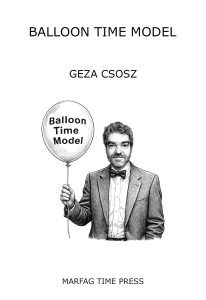
The Balloon Time Model offers a radical yet intuitive approach to thinking about time. Rather than treating the present as a stable, measurable point, the model describes time as a continuously expanding structure, similar to a balloon, where the past and the future are not separated by a clear boundary and the ‘now’ has no physical thickness.
Drawing on concepts from mathematics, art, and philosophy, the model challenges linear, clock-based intuitions and invites the reader to reconsider time as a dynamic, relational process rather than a fixed container of events.